Kentucky's Racing Renaissance: How Gaming Funds Transformed Betting in the Bluegrass State

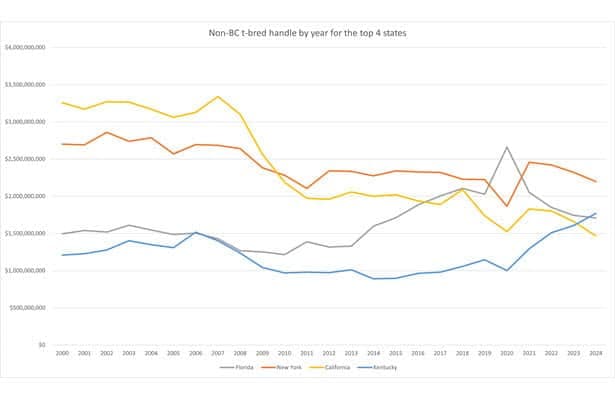
The horse capital of the world is making strides in the betting scene. Kentucky, once lagging behind in total handle, has now overtaken California and Florida to secure the second position overall in American Thoroughbred racing, trailing only New York.
Historical Context
Kentucky's journey from the lowest handle among the big four states (California, Florida, New York) to its current success is noteworthy. From a mere $890 million in 2014, Kentucky's handle skyrocketed to $1.77 billion in 2024. This transformation was fueled by the introduction of historical horse racing machines in early 2021, which provided both a new revenue stream and a bettor-friendly initiative.
Handle Growth
- 2014: $890 million
- 2024: $1.77 billion
The numbers speak for themselves, showcasing a 98.7% increase since 2014. In contrast, New York has seen a 3.3% decline in handle over the same timeframe, while California has dropped by 28.8%.
Legislative Support
Damon Thayer, Kentucky's former senate majority leader, expressed confidence in the state's potential, stating, "With the passage of the historical horse racing bill in 2021, I had confidence that we’d have the best year-round circuit in North America." This legislation has established a model that other states could emulate, ensuring protections for purses and horses.
Collaborative Efforts
Kentucky's success is attributed to a collective effort among various stakeholders, including racetracks, horsemen organizations, and legislative officials. Gary Palmisano Jr., vice president of racing at Churchill Downs, emphasized that improved collaboration has enhanced the wagering product, attracting horseplayers to the state.
Competitive Landscape
The average field size has grown from 8.1 horses in 2014 to a record 8.9 in 2024, reflecting a thriving racing environment. Jim Goodman from Keeneland Association commented on the positive impact of full fields and effective promotion in attracting bettors.
Future Considerations
Despite the success, questions arise about whether Kentucky's growth might overshadow other states. Goodman noted, "Kentucky is unique in that everybody knows how important Thoroughbred racing is to this state." However, Thayer firmly stated that Kentucky’s focus remains on enhancing its own racing industry rather than assisting others.
Funding and Strategy
The Kentucky Thoroughbred Development Fund (KTDF) plays a crucial role in supporting breeders, owners, and racetracks through strategic marketing and public relations efforts. In the fiscal year ending July 31, 2024, Kentucky's racetracks handled $9.6 billion on historical horse racing, contributing $55.5 million to the Thoroughbred fund.
"All stakeholders are focused on maximizing Kentucky’s product to increase handle," said Chauncey Morris, executive director of the Kentucky Thoroughbred Association. The strategic allocation of funds is aimed at improving everyday racing and maintaining Kentucky’s status as a premier racing destination.
- #kentucky
- #horseracing
- #betting
- #gamingfunds
- #thoroughbred
Comments · 0