How Google's AI Overviews Are Killing Small Business Websites: One Designer's Shocking Story

The Day Everything Changed
Scott Wetterschneider was scrolling through X in July when he stumbled upon a Pew Research Center report that made his stomach drop. The report detailed how Google's AI Overviews were changing user behavior—people were clicking less on search results when AI summaries appeared.
Suddenly, a mystery that had been bothering him for months clicked into place. His website traffic had dried up, and he realized: Google was scraping his content to power its AI answers, and users no longer needed to visit his site.
A Decade of Work, Gone in an Instant
Wetterschneider runs a virtual toy design business and built his website in 2011. By 2024, he had established himself as a trusted resource in his niche, answering common questions from aspiring designers. He relied on Google Search for free advertising, as his high rankings helped him secure client jobs.
"I was counting on my website to perform," he said. In the past, studios and independent artists would discover his site via Google and reach out to collaborate. But over the last year, those emails slowed to a trickle.
The AI Overview Effect
Google rolled out AI Overviews in May 2024, and they've become increasingly ubiquitous. These AI-generated summaries appear at the top of search results, pulling information from websites like Wetterschneider's. The result? Traffic plummets for the very sites that provide the information.
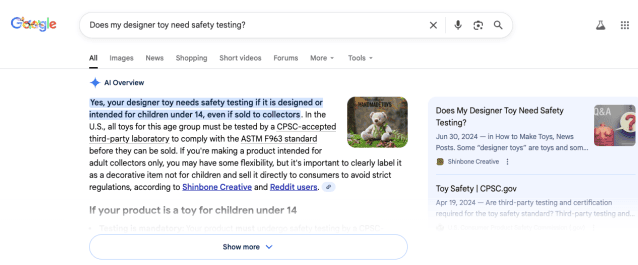
Photo Credit: Google
When The Cool Down tested searches related to Wetterschneider's niche—like "Does my designer toy need safety testing?"—the AI summary credited his site, Shinbone Creative, as a top source. But users got their answer without clicking through.
An Industry-Wide Problem
This isn't just one designer's struggle. AI Overviews are suspected of slashing traffic across numerous industries:
- Law firms
- Retail stores
- News organizations
- Countless small businesses
Lily Ray, VP of SEO strategy at Amsive, warned: "If Google makes AI Mode the default in its current form, it's going to have a devastating impact on the internet. It will severely cut into the main source of revenue for most publishers and disincentivize content creators."
Analytics company Authoritas found that sites previously ranked first in Google search could lose up to 79% of their traffic because of AI Overviews.
The Legal Gray Area
Google hasn't responded to requests for comment on this specific case. Legally, the company is on solid ground—it's not illegal to scrape public sites for AI summaries, especially when sources are credited rather than content copied verbatim.
Beyond Business: The Environmental Cost
The rise of AI brings another concerning side effect: massive energy consumption. Researcher Jesse Dodge noted that "one query to ChatGPT uses approximately as much electricity as could light one light bulb for about 20 minutes."
Google's own 2024 sustainability report revealed a 48% increase in gas pollution since 2019, largely attributed to AI energy demands. "As we further integrate AI into our products, reducing emissions may be challenging," the report stated.
AI servers also require tremendous amounts of water for cooling. Researchers estimate that composing a 100-word email with AI requires 519 milliliters of water—roughly one single-use plastic water bottle's worth.
Fighting Back with Awareness
Wetterschneider has taken to social media to share his story, receiving sympathy from others facing similar challenges. While the traffic drop hasn't crippled him financially—thanks to strong client relationships—he's using his platform to warn others about AI's downsides.
"We're all trying to adapt," he said. "Ultimately, at the end of the day, the things I do cannot be done—even badly—by AI."
His experience serves as a cautionary tale for any business relying on organic search traffic in the age of AI-powered search.
- #googleai
- #seo
- #searchtraffic
- #contentscraping
- #aioverviews
Comments · 0