AI Search is Reshaping Marketing: How 10 Agencies Are Adapting to Win
AI search platforms like ChatGPT, Perplexity, Gemini, and Google’s AI Overviews are fundamentally changing how people discover information. Digital marketing agencies are feeling this impact firsthand and must adapt quickly to keep their services relevant, processes outcome-driven, and results easy to prove.
What AI Search Changes for Digital Marketing Agencies
Semrush predicted that AI search will surpass organic traffic by 2028. A growing number of people now start their searches with AI instead of traditional search engines like Google or Bing.
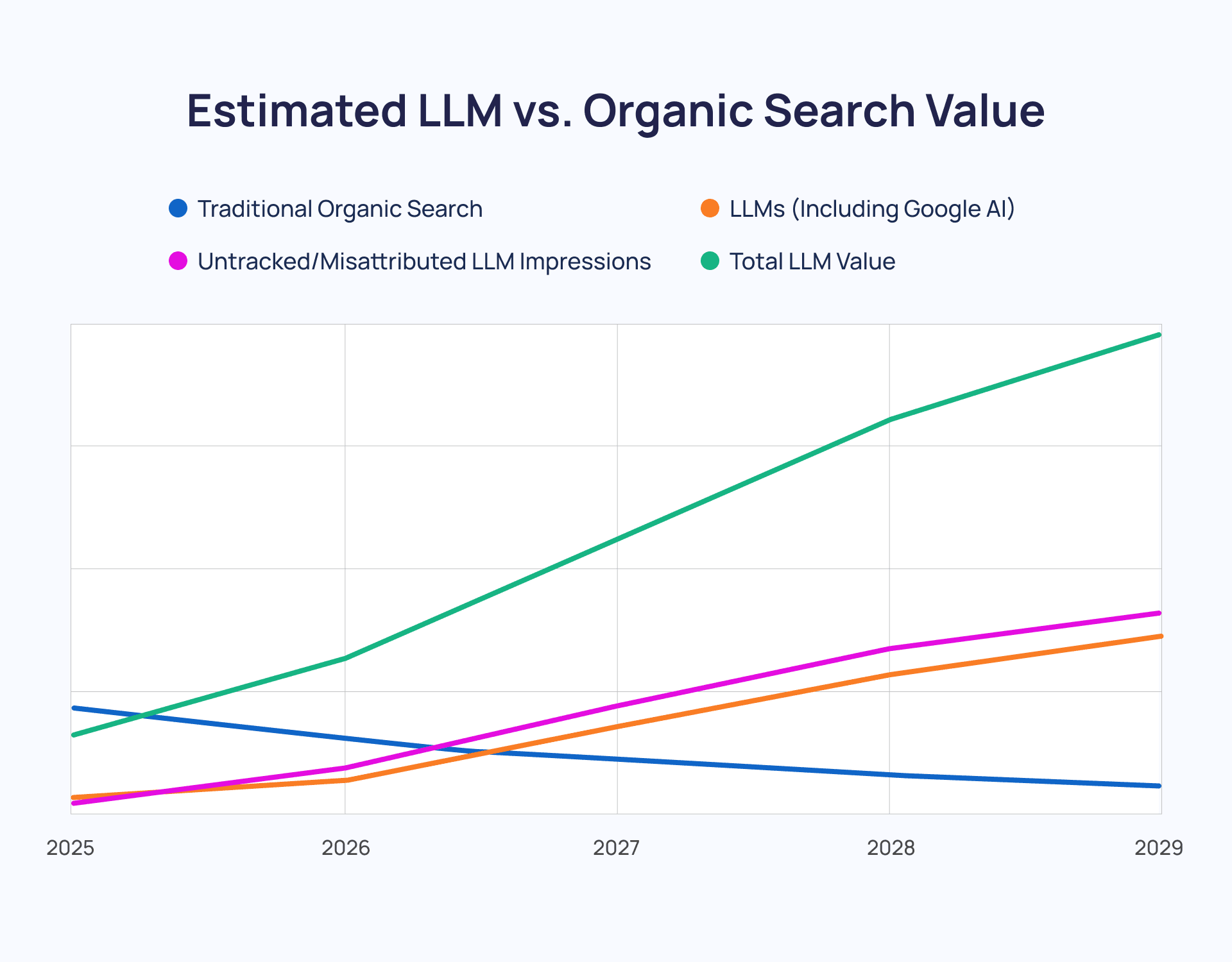
For informational queries, the journey often ends within the AI interface itself - ChatGPT, Perplexity, or Claude delivers complete answers without requiring clicks to external websites. This explains the sharp drop in click-through rates observed across the industry.
AI also compresses the customer journey dramatically. Instead of moving through multiple touchpoints, customers now research products directly with AI. This is why AI traffic converts 440% better than organic visits.
What does this shift mean for agencies? Several priorities stand out:
- Expand offerings to meet demand for AI search optimization while maintaining strong organic search performance
- Educate clients on how search is changing and why AI search matters
- Introduce new metrics that reflect performance in an AI-driven landscape
- Shift toward value-based selling and prove ROI as attribution becomes more challenging
How Agencies Are Adapting to the New Reality
We spoke with 10 industry leaders to learn how they've updated their processes and strategies to meet these new challenges.
Listicle Placements Replacing Traditional Link Building
Editorial.Link, a digital PR and link building agency, shifted its focus to listicle placements. Recent studies show that listicles are among the most frequently cited sources in AI search results. To support this shift, they built Listicle.com, an AI-powered tool that helps companies find relevant "best of" lists for brand placement.
Shifting from Keyword Optimization to Brand Entity Building
Ignite SEO moved beyond keyword-first optimization to focus on search intent and building recognizable brand entities. "We're connecting the dots between content, expertise, and reputation," said Adam Collins, founder of Ignite SEO. "The goal is to ensure that when AI engines search for trusted voices in a space, they need to know exactly who our clients are and why they matter."
More agencies now prioritize entity, authority, and intent optimization over traditional keyword-first tactics. Ben Foster, CEO of SEO Works, emphasized that an SEO agency's job is to make clients easy for both machines and people to understand.
Testing What Content Structures LLMs Favor
High Voltage SEO experiments with content structures and on-page formats to influence how Google and AI tools extract information. "Content must do more than rank," said Julia Munder, general manager at High Voltage. "It must be organized so AI can summarize it accurately and confidently."
Reverse-Engineering AI Ranking Signals
SEO Inc. has developed proprietary AI prompt frameworks to analyze SERPs, extract ranking signals, and run competitive intelligence at scale. Garry Grant, CEO at SEO Inc., believes the real differentiator will be how agencies use AI to decode search algorithms, anticipate SERP volatility, and uncover ranking opportunities.
Shifting Toward Search Everywhere Optimization
SEO Sherpa shifted from pure organic search to search everywhere optimization. "The role of agencies now is to optimize not just for Google, but for the entire ecosystem of AI-driven discovery," said Jenny Abouobaia, owned media manager at SEO Sherpa.
This means ensuring clients are visible, trusted, and recognizable across traditional search, generative engines, and platforms like Pinterest, TikTok, and Instagram - wherever their audience spends time.
Optimizing Reviews for Local Citations
For local businesses, AI search raises the importance of review platforms, especially Google. "By reaching top ranks on Google reviews in Google Maps or the local pack, businesses enjoy a high likelihood of being recommended by LLMs," said Robert Newman, founder and CEO of InboundREM.
Adding AI Visibility as a Core KPI
SeoProfy has built AI visibility tracking into its workflow. Alongside traditional SEO metrics, the team monitors LLM mentions, analyzing competitors and identifying which brands are cited by different chatbots for specific queries.
Blending GEO into Existing SEO Packages
First Rank initially treated AI search as a separate service but found that clients - especially local businesses - benefit more from integrated offerings. "We're sprinkling GEO-related tasks into SEO campaigns," said Terry Williams, head of SEO at First Rank.
How Your Agency Needs to Adapt to AI Search
The patterns across these 10 agencies point to clear shifts:
- From rankings to visibility: Success now means showing up in AI-generated answers, not just chasing the #1 Google spot
- From keywords to entities: Optimization centers on building recognizable, trusted brand entities
- From traffic to authority: Link building has evolved into brand building, with backlinks serving as authority signals
- From measurement to influence: Traditional analytics miss AI search impact - track LLM citations and build custom measurement systems
- From SEO to search everywhere optimization: Agencies can't focus only on Google when discovery happens across multiple AI platforms
The fastest-moving agencies share one trait: they test aggressively, measure what they can, and educate clients on a shifting landscape while others still debate whether AI search even matters.
- #aisearch
- #digitalmarketing
- #seo
- #marketingstrategy
- #brandbuilding
Comments · 0